Types of Fold-Down Dining Tables
Understanding the various fold-down dining table designs is essential before evaluating their investment potential. Each type offers distinct advantages and comes with different price implications.
Wall-Mounted Fold-Down Tables
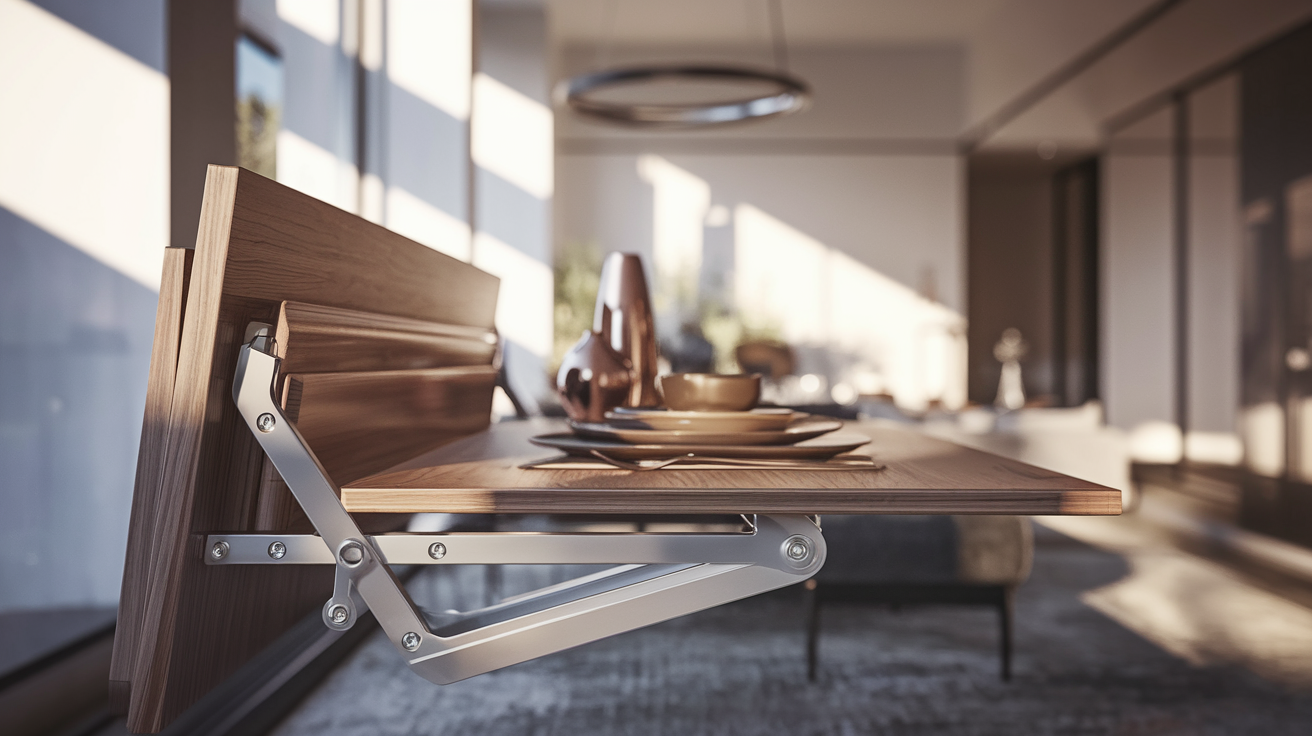
Wall-mounted fold-down tables, sometimes called Murphy tables, attach directly to your wall and fold flat when not in use. These tables require no floor space when stowed away, making them ideal for extremely compact spaces. The mounting mechanism typically consists of brackets and hinges that support the table when extended.
From a price perspective, basic wall-mounted tables start around $150-$300, while premium custom options with sophisticated mechanisms and higher-quality materials can range from $500 to well over $1,000. The ROI on these tables is particularly strong in micro-apartments or studios where floor space is extremely limited.
Drop-Leaf Tables
Drop-leaf tables feature hinged sections (leaves) that can be lowered or raised as needed. Unlike wall-mounted options, these are freestanding pieces that can be moved around. When the leaves are down, the table maintains a slim profile that can be positioned against a wall to maximize available floor space.
Price ranges for drop-leaf tables typically fall between $250-$800 for quality options, with antique or designer pieces commanding higher prices. These represent a flexible middle ground in the fold-down table category, offering portability along with space-saving benefits.
Convertible and Extendable Tables
Convertible tables can transform from coffee table height to dining height, while extendable tables include leaves or sections that can be added to increase the dining surface. These sophisticated options provide versatility beyond simple space-saving.
Due to their complex mechanisms and dual functionality, convertible and extendable tables generally represent the highest investment in the fold-down category, ranging from $600 to $2,500 depending on materials, design sophistication, and brand reputation. However, they also potentially offer the highest ROI by replacing multiple furniture pieces with a single solution.
Key Factors That Influence Pricing
The cost of a fold-down dining table varies significantly based on several key factors. Understanding these elements helps you make informed decisions about where to invest and where to economize.
Materials and Construction
The materials used in construction represent the most significant price determinant for fold-down tables. Engineered wood products like MDF or particleboard with laminate finishes occupy the lower end of the price spectrum ($150-$400). Mid-range options typically feature solid wood components for structural elements with veneer surfaces ($400-$800). Premium tables constructed from solid hardwoods like oak, walnut, or maple command prices from $800 to $2,500+.
Beyond the visible materials, the quality of hinges, brackets, and folding mechanisms significantly impacts both price and longevity. Commercial-grade hardware may add to the initial cost but dramatically improves the table's lifespan and operational reliability—a crucial consideration when calculating long-term ROI.
Size and Capacity
Fold-down tables designed to seat two people naturally cost less than those accommodating six or more diners. Compact models typically measure 24-36 inches in diameter or width and range from $150-$500. Mid-sized options seating 4-6 people generally fall between $400-$900. Large capacity tables that can host 6-8 diners when extended typically start around $800 and can exceed $2,000 depending on materials and mechanism sophistication.
When evaluating ROI, consider not just the current household size but anticipated entertaining needs. A slightly larger table may offer better long-term value if it eliminates the need to purchase additional seating solutions for occasional gatherings.
Design and Brand Premium
Designer fold-down tables from recognized furniture brands can command significant premiums—often 30-50% above comparable non-branded options. While these carry prestige and potentially stronger resale value, the functional benefits may be identical to quality options from direct-to-consumer brands like Smart Living.
When calculating ROI, consider whether the brand premium delivers tangible benefits in terms of warranty coverage, customer service, or design exclusivity that justifies the additional investment. Often, the most cost-effective approach involves selecting direct-source products that offer equivalent quality without the retail markup.
Comprehensive Price Range Breakdown
To help you budget effectively, here's a detailed breakdown of what you can expect at different price points in today's market.
Entry-Level ($150-$350)
At this price point, you'll typically find simple wall-mounted drop-down tables constructed from engineered wood or MDF with laminate finishes. These tables generally accommodate 2-3 people and feature basic folding mechanisms. While functional, these entry-level options may have limited durability with daily use and typically offer fewer design options.
For occasional use in a small apartment, these can provide adequate functionality and reasonable ROI, especially for temporary living situations where long-term durability is less critical. Many home goods retailers and online marketplaces offer these budget-friendly options.
Mid-Range ($350-$800)
The mid-range category represents the sweet spot for value in fold-down dining tables. At this price point, you'll find options with improved materials like solid wood components, better hardware, and more refined design aesthetics. Tables in this range typically seat 2-4 people comfortably and offer smoother operation and greater stability.
From an ROI perspective, mid-range tables from direct-to-consumer brands like those found in Smart Home collections often provide the best balance between quality and cost. These tables tend to last 7-10 years with proper care, making them suitable for both homeowners and long-term renters.
Premium ($800-$2,000+)
Premium fold-down tables feature top-quality materials like solid hardwoods, precision-engineered mechanisms, and sophisticated designs that blend seamlessly with high-end interiors. These tables typically offer additional features such as self-storing leaves, integrated storage, or unique transformation capabilities.
While the initial investment is substantial, premium tables from quality manufacturers can last decades with proper care. For permanent residences, the long-term ROI can justify the higher upfront cost, especially when factoring in the furniture's resale value and the elimination of replacement costs over time.
Custom and Designer Options ($2,000+)
Custom-made fold-down tables and designer pieces represent the highest tier of the market. These tables offer bespoke dimensions, unique design features, and premium materials tailored to specific spaces and aesthetic preferences. While the ROI on these investments may not be purely financial, they can add significant value to specialty properties and serve as statement pieces that enhance overall interior design.
Understanding ROI for Fold-Down Tables
The return on investment for fold-down dining tables extends beyond simple furniture economics. To calculate the true ROI, consider multiple factors that contribute to both tangible and intangible returns.
Space Efficiency Value
The primary ROI factor for fold-down tables is the value of reclaimed space. To quantify this benefit, calculate the square footage saved when the table is stowed away and multiply it by your property's price per square foot. For example, a standard dining table might occupy 20-30 square feet. In urban markets where real estate averages $500-1,500 per square foot, the space-saving benefit alone can represent $10,000-$45,000 in theoretical property value.
For renters, this calculation might translate to the ability to lease a smaller unit. The difference in monthly rent between appropriately sized units with and without permanent dining space can range from $200-$600 per month in major metropolitan areas—potentially saving $2,400-$7,200 annually.
Multi-Functionality Returns
Many fold-down tables, particularly those found in Smart Office collections, serve multiple purposes beyond dining. When calculating ROI, consider the cost of furniture pieces eliminated by the multi-functionality of your fold-down table (like a dedicated desk or console table).
For instance, if a convertible table functions as both dining table and home office desk, subtract the cost of a standalone desk ($200-$800) from the effective cost of your fold-down table. This adjustment often significantly improves the calculated ROI by distributing the investment across multiple furniture functions.
Longevity and Depreciation
Quality fold-down tables depreciate more slowly than many furniture pieces due to their specialized functionality. While standard furniture typically depreciates 20-30% in the first year and 10-15% annually thereafter, well-constructed fold-down tables from reputable manufacturers often retain 60-70% of their value after five years.
To maximize ROI, divide the table's cost by its expected lifespan. A $600 table with a 10-year useful life costs effectively $60 per year—a reasonable investment for daily functionality. Premium tables costing $1,200 but lasting 20+ years may actually represent better long-term value at $60 or less per year of service.
Interactive Price & ROI Calculator
To determine the true value of your fold-down table investment, consider the following calculation factors:
Initial Investment Calculation:
- Base price of fold-down table
- Shipping and delivery costs
- Installation costs (if applicable)
- Additional accessories or customizations
ROI Calculation Factors:
- Square footage saved (compared to traditional dining table)
- Your property value per square foot
- Alternative furniture costs avoided
- Expected lifespan of the table
- Potential resale value
Using these factors, our simplified ROI formula is:
5-Year ROI = [(Space Value + Avoided Costs + Resale Value) - Total Investment] / Total Investment × 100%
Where:
- Space Value = Square feet saved × Property value per square foot
- Avoided Costs = Cost of furniture pieces that would otherwise be needed
- Resale Value = Estimated value of the table after 5 years
- Total Investment = Base price + Shipping + Installation + Accessories
For example, a $600 wall-mounted fold-down table that saves 20 square feet in a property valued at $500 per square foot, eliminates the need for a $300 desk, and retains $300 in resale value after 5 years would calculate as:
5-Year ROI = [($10,000 + $300 + $300) - $600] / $600 × 100% = 1,667%
This extraordinary return demonstrates why fold-down tables are considered such valuable investments in space-constrained environments.
The Value of Space: Beyond Financial Returns
Beyond the calculable financial returns, fold-down dining tables deliver significant quality-of-life benefits that should factor into your investment decision.
Research has consistently shown that perceived spaciousness directly impacts psychological well-being. Open, uncluttered spaces reduce stress hormones and improve mental clarity. By enabling multi-functional use of limited square footage, fold-down tables contribute to this sense of spaciousness even in compact living environments.
Additionally, the flexibility offered by these tables enhances lifestyle adaptability. Entertaining becomes possible in spaces that would otherwise be too constrained, and daily transitions between activities become seamless. These quality-of-life improvements represent real value that transcends pure financial calculations.
For homes with multiple occupants, fold-down tables can also reduce spatial conflicts by creating clear demarcations between different activities while still allowing shared use of the same physical area. This harmonizing effect contributes to household cohesion—an intangible but significant benefit.
Quality Considerations When Investing
The long-term ROI of your fold-down table investment depends heavily on selecting a quality product that will maintain functionality for years to come. Key quality indicators to evaluate include:
Hardware and Mechanisms
The folding mechanism represents the most critical component affecting both usability and longevity. Look for tables with stainless steel or brass hardware rather than painted or plated metals, which may corrode over time. Gas pistons or counterbalanced designs offer smoother operation than basic hinges and reduce the risk of sudden drops that can cause injuries or damage.
Quality hardware often comes with weight ratings that indicate how much the extended table can safely support. For dining tables, look for support ratings of at least 100 pounds to ensure stability during normal use. Smart Living's products in their Smart Appliances collection typically feature commercial-grade hardware that exceeds residential requirements.
Material Durability
Since fold-down tables experience more mechanical stress than static furniture, material quality significantly impacts lifespan. Solid hardwoods withstand repeated folding and unfolding better than particle board constructions. If selecting engineered wood products, look for high-density fiberboard (HDF) rather than standard MDF or particleboard for improved durability.
For surface finishes, catalyzed lacquers and conversion varnishes offer superior scratch and moisture resistance compared to standard polyurethane finishes. These professional-grade finishes may add 10-15% to the purchase price but can double the effective lifespan of the table surface.
Warranty and Support
A manufacturer's warranty often reflects their confidence in product durability. Look for warranties that specifically cover the folding mechanism, not just general construction. Industry leaders typically offer 3-5 year warranties on mechanisms and 1-2 years on finishes and non-moving parts.
Beyond the formal warranty, evaluate the manufacturer's reputation for customer support. The availability of replacement parts and repair services significantly extends a product's useful life and enhances ROI. Direct-to-consumer brands like Smart Living often provide superior customer support compared to traditional retail models since they maintain direct relationships with both manufacturers and end users.
Installation Costs and Considerations
Installation requirements vary significantly based on the type of fold-down table you select. Factoring these costs into your initial investment calculation ensures a more accurate ROI assessment.
Wall-Mounted Table Installation
Wall-mounted fold-down tables require secure attachment to wall studs or solid masonry. DIY installation is possible for those with moderate home improvement skills, requiring basic tools like a stud finder, level, drill, and appropriate anchors. If hiring a professional, installation typically costs $100-$250 depending on your location and wall construction.
Structural considerations are paramount—the table must be securely mounted to support both its own weight and the dynamic loads placed upon it during use. Most manufacturers provide detailed installation instructions specifying required mounting points and weight capacities. Failure to follow these guidelines can result in both safety hazards and voided warranties.
Self-Standing Options
Drop-leaf and convertible tables generally require minimal or no installation, making them suitable for renters or those who prefer flexibility in furniture placement. These tables typically arrive fully assembled or require basic owner assembly similar to other furniture pieces.
While avoiding installation costs, these options may require greater initial floor space than wall-mounted alternatives. When calculating space efficiency ROI, consider the footprint of the table in its folded position, not just when fully extended.
Custom Installation Scenarios
For built-in fold-down tables integrated with cabinetry or custom wall systems, installation becomes more complex and typically requires professional carpentry services. These custom installations can range from $500 to $1,500 depending on complexity and materials.
While representing a higher initial investment, custom installations often deliver superior aesthetics and functionality tailored to specific spaces. The ROI calculation should factor in the potential increase in property value from these built-in improvements, which generally recoup 60-80% of their cost in home valuation.